What If China Restricts Open-Weight AI Models?
What happens to AI inference providers if Open Weight AI labs stop releasing model weights? Exploring China's proposed AI export controls, billion-dollar valuations, and the long-term future of AI infrastructure.

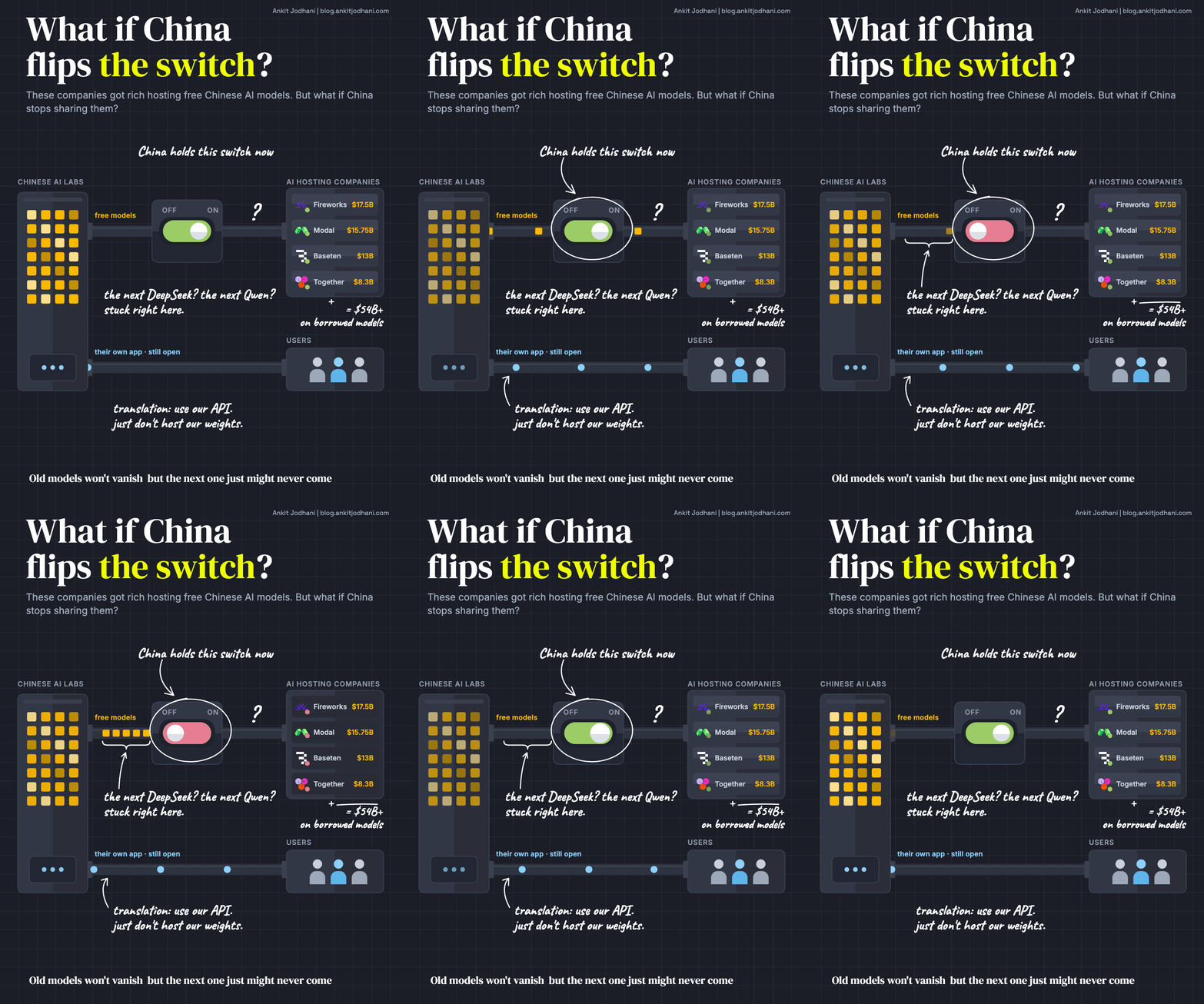
Today there are so many AI inference providers sitting on billions of dollars in valuation
- Fireworks AI went from $4B to $17.5B in around 9 months
- Baseten went from $5B in January to $13B in June
- Modal went from $4.65B in May to $15.75B in October
- Together AI is at $8.3B. fal at $4.5B
these are some crazy numbers. aren't they?
And I'm not saying they don't deserve these valuations. The demand for AI infrastructure is clearly exploding.
but what happens if tomorrow the companies building the best AI models simply stop sharing their weights?
Or let's say China decides that the next DeepSeek, Qwen, Kimi or GLM model can only be accessed through an APIs
You can use the model but you just can't download its weights and host it yourself in the US or Europe.
What happens to these inference providers then?
And the interesting thing is, this isn't even a completely hypothetical question anymore
On October 16, China proposed export controls covering advanced AI technologies, including model weights.
Now, it's not a ban. The proposal excludes technology that's already publicly open-sourced, and new open-source releases can qualify for automatic licensing.
But here's what caught my attention.
Calling a model through an API is treated differently from transferring the actual model technology abroad.
That distinction is very interesting.
Because a big part of the inference business depends on exactly that ability to take someone else's model and run it on your own infrastructure.
And think about it.
If China can restrict the export of rare earth minerals, couldn't it eventually do something similar with its most advanced AI models?
Of course, model weights are different from minerals. Once they're released publicly, you can't really take them back.
But you don't need to take back yesterday's models. you just need to control who gets tomorrow's.
And in AI, that matters a lot. The model everyone wants to use today might not be the model everyone wants six months from now.
Chinese open-weight models have already become a huge part of the ecosystem. On OpenRouter, Chinese models even overtook US models in token usage earlier this year.
Now imagine the next generation of those models goes API-only.
I genuinely wonder how the inference providers would respond.
- Will they eventually become AI labs themselves?
- Will they start building their own models?
- Or will they turn into something closer to cloud companies, where the real business is compute, optimization, fine-tuning, and helping enterprises run their own specialized models?
because when I look at the business from outside, a lot of it seems to be taking someone else's model, hosting it, making it faster and cheaper, adding compliance, data residency, reliability, and then selling access..
And to be fair, that's NOT easy. Inference optimization is SERIOUS Engineering. Running these models reliably at scale is genuinely difficult.
also, some companies are already moving beyond just hosting models.
Fireworks says over 95% of its tokens come from models specialized for customers. Modal is building a massive business around infrastructure for AI agents, not just inference.
So maybe that's where this whole industry is heading but I'm still trying to understand the long-term moat.
If you don't control the underlying model, and the company building it can decide tomorrow how you access it, how much control do you really have over your business?
Especially when inference prices keep falling and the model creators themselves can compete with you.
- Maybe these companies will become the next generation of cloud infrastructure.
- Maybe a few will become full AI labs.
- Maybe the real winners will be the ones that own the customer relationship and the entire deployment layer, regardless of which model is popular.
I don't know...
but when I see these valuations, I keep coming back to the same question..
Are investors valuing the infrastructure these companies are building, or are they assuming the world's best AI models will always remain open for anyone to host?
Because releasing model weights is ultimately a choice.
and that CHOICE can CHANGE. Right?
really curious what people building in this space think.
or Am I missing something?
Feel free to point out any mistakes if I'm wrong (i always welcome feedback)